- What follow are, in no particular order, some thoughts on this subject.
- Slowing the creational process down to the speed of thought is crucial; without it, poetry simply can’t happen. This applies equally to the original versifying (in the Urdu and Farsi languages, as done by Hazrat Mirza Ghulam Ahmad) as it does to translating (those original verses into the English language, the ones featured on this site.)
- And the indispensable aid to achieving that slow rhythm—one which enables the tendrils of versifying to gain purchase—is the trusty duo of pen and paper.
- I hear some gasps. But versifying simply cannot be done by turbo-typing one’s way through the computer screen, to a certain way of thinking, and as far as I’ve been able to tell.
- With those thoughts in mind, I now invite you to witness—taking you behind the scenes—how such a creational process actually unfolded.
- And we do so by way of a view of my inspired poem-translation—witness Exhibit A below—a scattering committed to college-ruled paper, in longhand, decked-out (below) on a sheet of verdant expanse that’s all green and emblazoned with osculating circles, striking notes of civility and polite diffidence.

- Much as I said up atop, these are only some (loose) thoughts; nothing systematic; and if it were, it wouldn’t be poetry, or would it?
- The translation process—if there is one, and here I refer you to my preceding musing—is one of “mapping” between the two language: We cross the chasm of what I’m going to call “the linguistic divide.” And now’s the perfect time to illustrate (with Exhibit B below) what I’ve got in mind.
- So the left-hand side of this aforementioned “linguistic divide” (representing the Urdu language, being one of the two languages in which the Promised Messiah versified), and the right-hand side (representing the English language) make up the universe of this process.
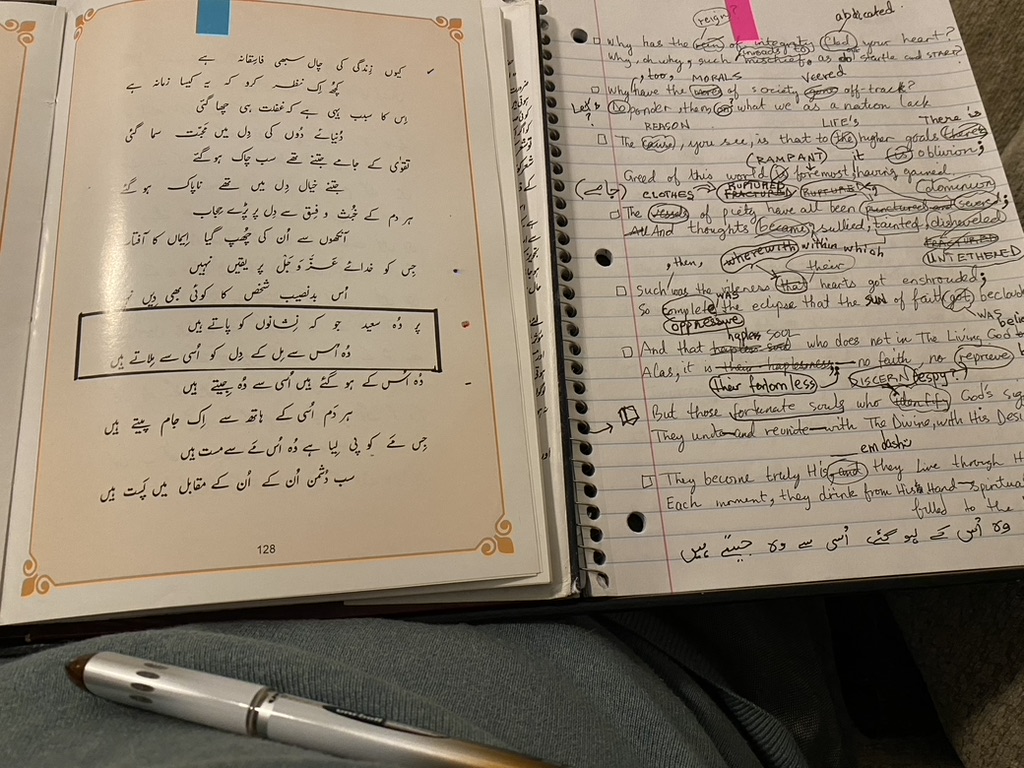
- And that—Exhibit B above—is exactly what I had in mind when boldly stating up atop that “the indispensable aid to achieving that slow rhythm… is the trusty duo of pen and paper.”
- Please know that I’ll be happy as a clam if (the translations of) the verses of rhyme presented on this website bring even a glimmer of the lyric glory suffusing Hazrat Mirza Ghulam Ahmad’s own poetry. All that’s left now—and this is for those of you who can read the Urdu language—is for you to check the (accompanying) original verses of rhyme (in native Urdu), the ones that inspired me to write the “inspired” translations.
- Having the two versions—the “inspired” English translation which appear and the “original” verses in Urdu that appear—readily available will, I believe, only add to your enjoyment.
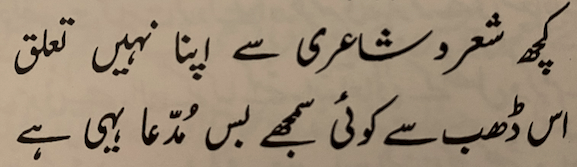
- The only other thing I can think of is to make you aware of is the Promised Messiah’s own position regarding the enterprise of versification itself. Starkly stated, and in his own words in the Urdu language:
Okay, I’ll stop now—the faster I get out of your way, the quicker you can get to the true content that’s featured on this site: the breathtaking honesty and spirituality pervading the verses of rhyme by the Promised Messiah.


Leave a Reply